

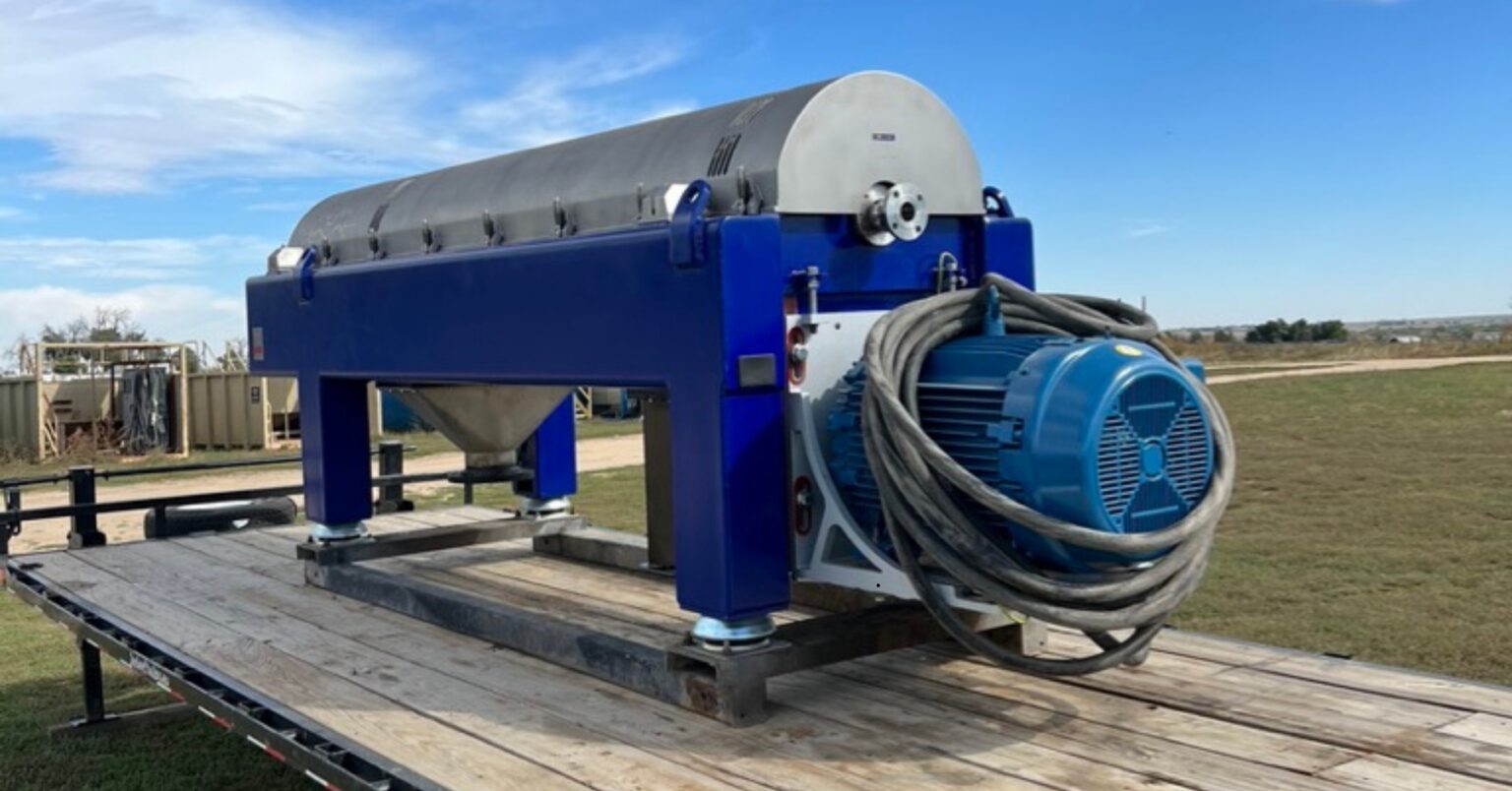
G-force is the centrifugal separation power a decanter centrifuge generates at operating speed. It determines the cut point, which is the smallest particle size the unit can reliably capture, and it’s the specification most directly tied to whether a centrifuge performs under difficult operating conditions.
In applications where the finest fraction determines process outcomes, the centrifuge is the last recovery point for that material, and G-force determines how much of it gets captured. The units most frequently evaluated for this work include the Alfa Laval Lynx family and three models from Grizzly Centrifuges, Kayden Industries’ rebranded product line:
- Alfa Laval Lynx 50
- Alfa Laval Lynx 65
- Alfa Laval Lynx 72
- Alfa Laval Lynx 100
- Grizzly Mammoth 2276
- Grizzly Kodiak 2276-125
- Grizzly Kodiak 2276-150
Below, we compare their specifications directly, explain what each number means at the bowl level, and break down how the performance differences affect your operation.
Specification Comparison
Lynx 50 vs. Grizzly Mammoth Centrifuge Models
| Equipment | Bowl Diameter | Max RPM | Max G-Force |
| Lynx 50 | 19.7″ (500mm) | 3,600 | 3,629 G |
| Grizzly Mammoth 2276 | 22” (560mm) | 2,350 | 1,725 G |
| Grizzly Kodiak 2276-125 | 22″ (560mm) | 3,350 | 3,506 G |
| Grizzly Kodiak 2276-150 | 22” (560mm) | 3,350 | 3,506 G |
NOTE: The Kodiak 2276-125 and 2276-150 share identical bowl dimensions, RPM, and G-force. The difference is motor configuration: 125 HP vs. 150 HP main drive.
Alfa Laval Lynx Family G-Force Performance at Larger Bowl Diameters
No Grizzly model operates in this bowl size range. The Lynx 65, 72, and 100 offer progressively higher throughput while maintaining the G-force levels required for fine particle recovery.
| Equipment | Bowl Diameter | Max RPM | Max G-Force |
| Lynx 65 | 25.6″ (650mm) | 3,100 | 3,498 G |
| Lynx 72 | 28.3″ (720mm) | 2,900 | 3,391 G |
| Lynx 100 | 39.4″ (1,000mm) | 1,875 | 1,969 G |
READ MORE: Alfa Laval vs. Other Decanter Centrifuges
The Ultra-Fine Threshold
44 microns is the particle size that passes through a 325-mesh screen, marking the practical lower limit of what conventional separation equipment can reliably recover. Below that threshold, capturing the remaining material depends entirely on a high-G solid bowl centrifuge.
The spread between 1,725 G and 3,629 G in the table is a direct expression of that gap, and it determines whether the finest, highest-value fraction gets captured or is left in the centrate.
What G-Force, RPM, and Drive Architecture Each Determine
G-Force Determines Cut Point
G-force sets the cut point, which is the smallest particle a centrifuge can reliably capture under operating conditions. As G-force increases, finer particles gain enough settling velocity to reach the bowl wall and discharge as recovered solids. When G-force falls short of what the particle size demands, those particles leave with the centrate.
Here’s how cut point performance compares across the units in this comparison:
- Lynx 50, 65, 72 — Alfa Laval puts the D50 cut point below 6 microns at full operating G-force, capturing the ultra-fine fraction consistently
- Grizzly Kodiak 2276 — at 3,506 G, operates within the same G-force range as the Lynx family and approaches the same cut point threshold
- Grizzly Mammoth 2276 — at 1,725 G, operates with a cut point well above that threshold, losing a meaningful share of the ultra-fine fraction to the centrate
The Lynx 50 leads the comparison at 3,629 G. On applications where the finest particles carry the most recovery value, that difference in cut point is where performance separates.
RPM (Not Bowl Diameter) Determines G-Force
All three Grizzly models in the first table run 22-inch bowls, slightly larger than the Lynx 50’s 19.7-inch bowl, so the G-force gap between them is unrelated to bowl size. It comes from RPM. Structural limits on rotating assemblies constrain maximum bowl speed, which is why a larger bowl doesn’t automatically produce higher G-force.
The Mammoth 2276 tops out at 2,350 RPM and produces 1,725 G. The Kodiak 2276 reaches 3,350 RPM on the same bowl and produces 3,506 G. The Lynx 50 reaches 3,600 RPM on a slightly smaller bowl and produces 3,629 G. The Lynx 50 also offers higher hydraulic throughput, so the G-force advantage doesn’t come at the expense of volume.
READ MORE: The Impact of Solids on Drilling Efficiency
Drive Architecture Determines Whether G-Force Holds in the Field
G-force is calculated at rated bowl speed. When solids loading increases mid-operation, the scroll conveyor experiences more torque resistance, and how the drive system handles that resistance determines whether rated bowl speed holds or drops.
The Alfa Laval direct drive is designed to detect the torque increase and adjust the differential speed within the operating cycle, keeping the bowl at a consistent speed and maintaining the separation performance specified in the spec sheet. Drive systems that cannot respond to load changes that quickly allow solids loading variations to translate directly into G-force variation, which is where the gap between spec sheet performance and field performance opens up.
For operations running the Lynx 50, 65, or 72, that responsiveness is what makes the G-force advantage in the table hold across a full shift rather than only under controlled conditions.
How G-Force Requirements Vary by Application
Not every application demands the same G-force threshold, and not every Lynx model is built around the same design priority. The Lynx 50, 65, and 72 are optimized for G-force. The Lynx 100 is optimized for throughput.
Lynx 100 Specifications
| Specification | Value |
| Bowl Diameter | 39.4″ (1,000mm) |
| Max RPM | 1,875 |
| Max G-Force | 1,969 G |
| Hydraulic Capacity | 2376 GPM |
Structural limits constrain maximum speed in large rotating assemblies, which is why the Lynx 100’s G-force doesn’t scale with its bowl size. At 2376 GPM, it processes feed volumes that no other centrifuge model can match, and its direct-drive architecture maintains consistent performance at that flow rate.
For operations where throughput is the governing requirement and a 2,000 G cut point meets the application, the Lynx 100 is the right unit. For ultra-fine separation in fine coal recovery or high-G drilling programs, the Lynx 50, 65, and 72 prioritize G-force.
Application Example: Fine Coal Recovery
Most coal preparation plants handle the ultra-fine fraction in sequence: classification cyclones, spirals, and screen bowl centrifuges recover the coarser material, and the minus-325 mesh fraction reports to the high-G solid bowl centrifuge. That’s the last recovery point in the plant.
At 1,725 G, the Mammoth 2276’s cut point is well above the sub-6-micron D50 performance the Lynx family achieves at full operating G-force. At that G-force level, sub-44-micron particles don’t reach the bowl wall within the available residence time and leave with the centrate. Field testing by Somerset Coal International found that 40-70% of sub-325-mesh material is lost during screen bowl processing, even when recirculating screen-drain material. A lower-G centrifuge on the ultra-fine circuit compounds that loss rather than closing it.
At 3,391 G to 3,629 G, the Lynx 50, 65, and 72 generate enough centrifugal acceleration to capture that fraction continuously. Coal prep operations that have shifted their ultra-fine circuits to Lynx units see the change first in effluent solids content, then in total plant yield.
Application Example: Oil and Gas Solids Control
In a drilling program, ultra-fine drilled solids in the 5-to-20-micron range cause the most damage to fluid properties when they stay in the active system, and they’re the hardest fraction to capture. When G-force is too low to pull them out, they recirculate and the effects compound across the program, meaning:
- Ultra-fine low-gravity solids that aren’t captured recirculate through the active system, accelerating wear on surface pumps and downhole tools and driving up maintenance costs.
- Fine solids affect fluid rheology and push additive consumption higher as the program progresses.
- Fluid life shortens, compressing the window before the system requires correction.
READ MORE: What Are the Consequences of Poor Solids Control on Drilling Operations?
Conclusion
G-force determines the cut point, and the cut point determines what the centrifuge can and can’t recover. RPM establishes where that G-force figure comes from, and drive architecture determines whether it holds when operating conditions change. Together, those variables predict field performance in ways a spec sheet comparison alone won’t surface.
Before selecting separation equipment, the right questions to ask are:
- What G-force does this unit sustain under variable feed, not just at maximum RPM?
- Is that G-force sufficient to capture the particle sizes that matter in my application?
- What does the performance gap cost across the full program, not just on a given day?
- What throughput does this unit deliver at the RPM and G-force levels your application requires?
Those questions rarely come up in a standard evaluation, but the answers are what ultimately determines whether the centrifuge you select performs the way you need it to. If the equipment supplier can’t answer them, that’s worth knowing. And if they can, they’re the kind of partner who makes the difference between a solution that looks right on paper and one that holds up in the field.
As Alfa Laval’s Master Distributor, Diamond T Services operates the largest Lynx fleet in North America, with equipment available for immediate purchase or rental and 48-hour shipping turnarounds. Our pilot program validates separation performance against your actual feed material and operating conditions. Contact a Diamond T specialist to discuss your application.